
Fingerprint overrideNetwork interceptAutomationMessagingSystem proxySoftware authenticatorCredential injection
Chrovia SDK
Browser kernel development kit
Embed the Chrovia browser kernel into your product: 20+ licensed kernel capabilities and the Chrovia JS API drive fingerprinting, network interception, automation, and headless browsing — from internal workflows to commercial browsers.
Native kernel extensions20+ kernel capabilitiesThree desktop platforms
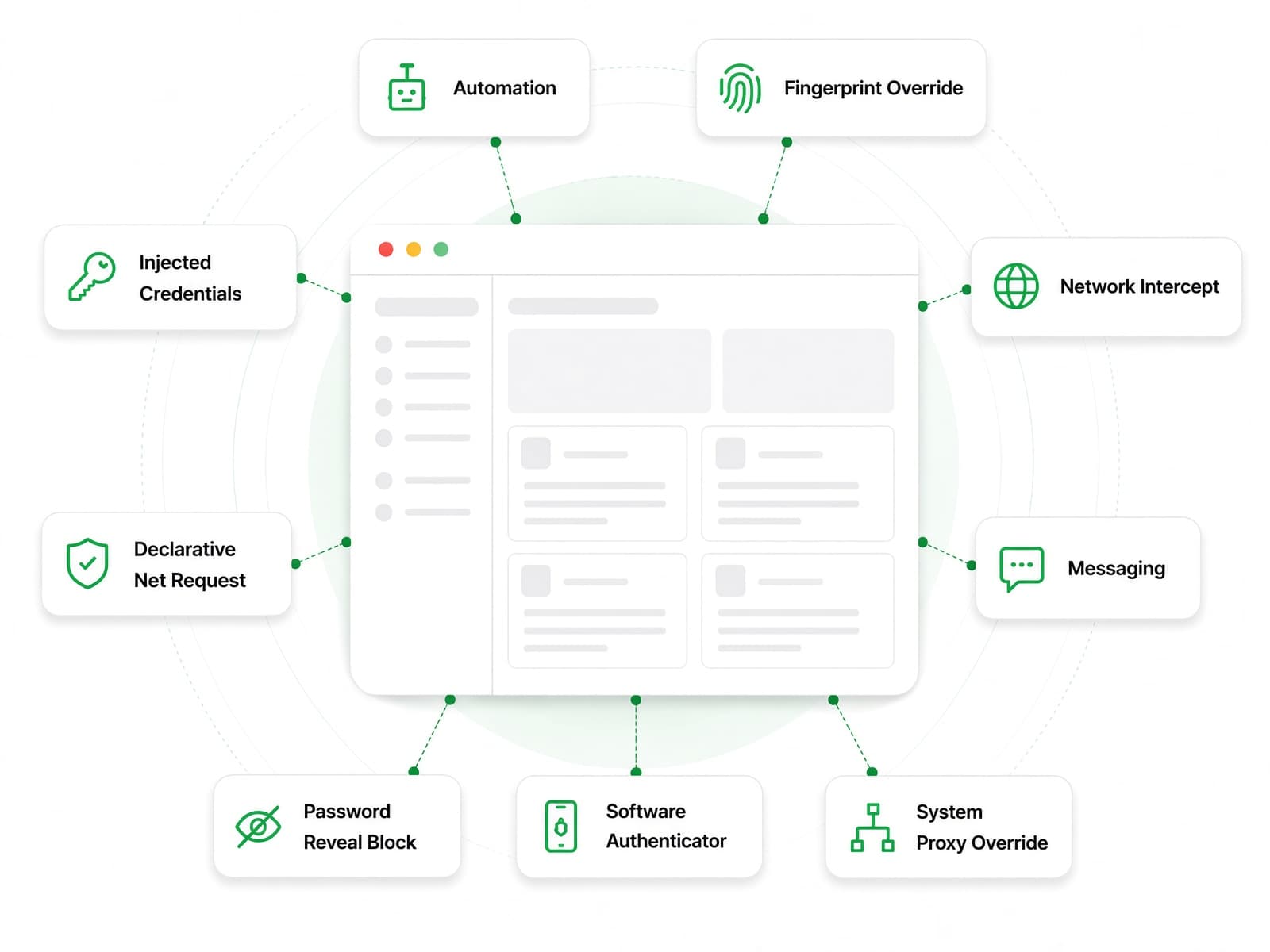
Capabilities
Every kernel capability you can put on a license. Capabilities stay off until they're granted — then you can call them.
Fingerprint Override
Override the device fingerprint per instance — user agent, timezone, hardware, fonts, and rendering traits — so pages see exactly the environment you define.
System Proxy Override
Override system proxies per instance with multi-hop chains and regional exits — every identity gets its own egress IP.
Injected Credentials
Preload accounts into an instance's credential store so login forms fill and submit themselves — open means logged in.
Network Intercept
Watch every request and response in real time, rewrite headers, parameters, or bodies as needed, or block outright.
Passwords
Read and write the instance password store: inject from the cloud at launch, sync changes back — credentials follow the identity.
Software Authenticator
Inject a software WebAuthn authenticator and log in with virtual passkeys — two-factor works even headless.
Automation
Drive the web programmatically: deep DOM access and trusted event dispatch, backed by a stable device fingerprint that passes bot checks without being flagged.
Declarative Net Request
Maintain static rules at the network layer: block, redirect, or allow requests by domain and URL pattern — applied before pages load, with near-zero overhead.
Disable DevTools
Turn off DevTools and remote debugging per instance so pages cannot be inspected or tampered with — no reverse-engineering your automation.
Extended Preferences
One preferences file manages identity, kernel, and product settings — change once, distribute to every instance.
Instance Appearance
Give each instance its own name, color, and icon — tell them apart at a glance, and ship products with their own branding.
Instance Metadata
Expose host, OS, hardware, and brand fields to pages so sites can read and verify a consistent instance identity.
Messaging
Exchange structured messages live between pages and your extension service worker — wire kernel capabilities into full workflows.
Native Dialog
Alerts, confirms, and pickers render as native Chromium dialogs — they match the OS and cannot be forged by pages.
Navigation Redirect
Redirect navigation to chosen addresses by URL pattern before the request leaves — force specific sites or block risky ones.
Password Reveal Block
Forbid revealing, toggling, or copying passwords in inputs — nothing to peek at or export in shared environments.
Process Management
Let your host app start and stop the browser — spawn on demand, pass arguments, observe lifecycle events.
Signed Extended Preferences
Preferences are signed server-side and verified before applying; local tampering invalidates them — only the issuer can change fingerprints.
Supervisor Process
Bind instances to a supervisor process; when it exits the browser closes too — no orphans in headless fleets.
Unrestricted API
The full Chrovia JS API runs in every page and worker with no extension context — wherever your script goes, capabilities follow.
Chrovia Studio
Don't learn the SDK from docs alone. Studio boots the real Chrovia kernel with a live gallery of reference demos—messaging, network intercept, credentials, automation, and more—so you can prove a workflow on your machine and take it to production.
Live capability galleryRun real reference demos for messaging, network intercept, credentials, automation, and more—not screenshots or mocks.
Prototype on your machineSign in, launch demos locally, and refine SDK workflows before shipping them.
Production kernelStudio ships the same hardened Chrovia kernel as the SDK, so demo behavior matches what you ship.